Shoulder and sports injury, Pune.
The rotator cuff decides the implant.
Home / Conditions / Shoulder Arthritis
Condition
Shoulder Arthritis: Symptoms and Treatment in Ahmedabad
By Dr. Kalpesh C. Patel · Consultant Orthopaedic Surgeon
Shoulder arthritis causes deep pain and a shoulder that gradually stops reaching. Treatment ranges from physiotherapy and injection through to shoulder replacement.
M.S. Orthopaedics
Arthroplasty fellowship, Taiwan
Practising since 2016
Practising in Ahmedabad
Your surgeon
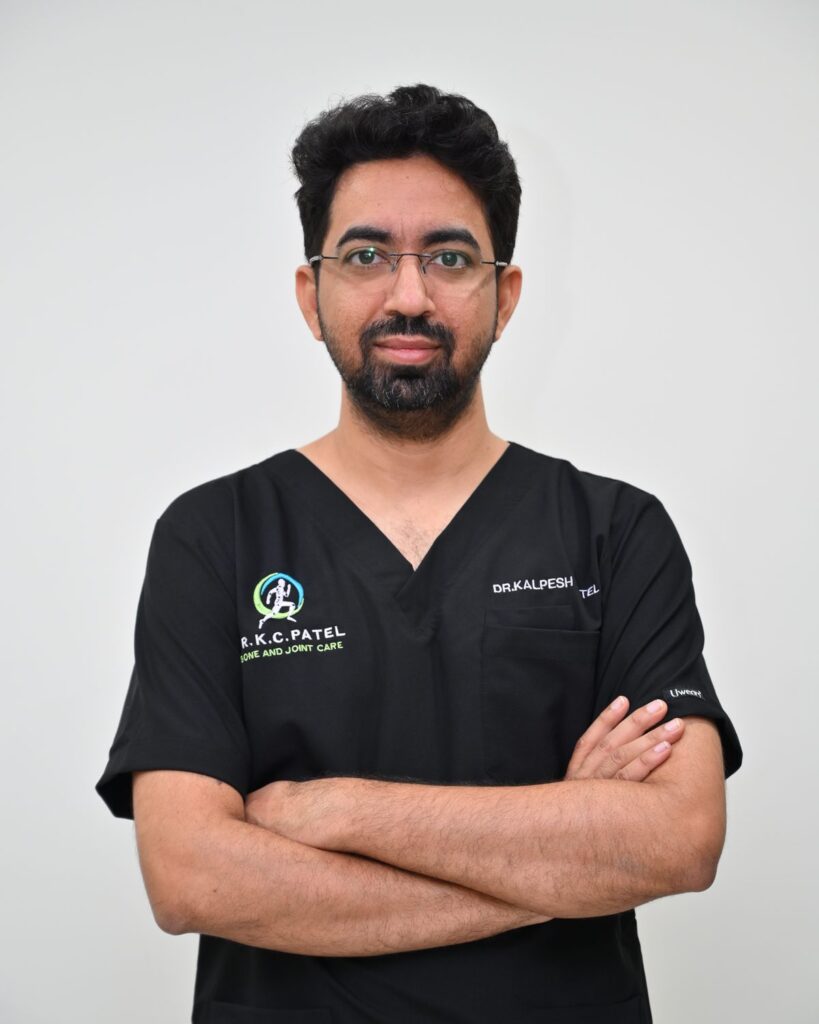
Meet Dr. Kalpesh C. Patel
Consultant Joint Replacement & Shoulder Surgeon
Dr. Patel trained in arthroplasty at Chang Gung Memorial Hospital in Taiwan and holds fellowships in revision arthroplasty and shoulder surgery. He has practised in Ahmedabad since 2016, with a focus on knee and hip replacement — including robotic-assisted and revision surgery.
M.B.B.S.
M.S. Orthopaedics
International Fellowship · Joint Replacement, Taiwan
Fellowship · Shoulder & Sports Injury, Pune
Years in orthopaedics
Fellowships
Peer-reviewed publications
Understanding the condition
What is shoulder arthritis?
Shoulder arthritis is wear of the cartilage in the ball-and-socket joint of the shoulder. It causes a deep, aching pain, grinding on movement, and a shoulder that reaches less and less — first behind the back, then overhead.
The rotator cuff, the sleeve of tendons that moves and stabilises the shoulder, matters here. If the cuff is intact, an anatomic shoulder replacement usually suits. If it is torn beyond repair, a reverse shoulder replacement works better, because it uses the deltoid muscle instead.
Common symptoms
- Deep pain in the shoulder, often worse at night
- Grinding or catching on movement
- Difficulty reaching behind the back or overhead
- Weakness lifting the arm
- Stiffness that has come on over months or years
See a doctor sooner if
- The shoulder is hot and swollen with fever
- You cannot lift the arm at all after an injury
- There is sudden weakness after a fall
- Night pain stops you sleeping
Causes
What causes a painful, stiff shoulder
Arthritis is one cause among several, and they are treated differently.
Osteoarthritis
Wear of the joint surface with age, causing pain and progressive loss of movement.
Rotator cuff arthropathy
Long-standing cuff tearing leads to arthritis, and the shoulder rides upwards.
Frozen shoulder
Painful, progressive stiffness, common in diabetes, which usually recovers without surgery.
After injury or instability
Fractures and repeated dislocations can wear the joint out early.
Treatment options for shoulder arthritis
Most shoulders start with physiotherapy. Replacement is for joints that are genuinely worn out.
Physiotherapy
A supervised programme for movement and strength, which settles many shoulders.
Injections
Used in selected cases to bring pain down far enough to rehabilitate the shoulder.
Arthroscopy
Keyhole surgery for cuff repair or for a shoulder that catches, where arthritis is not yet advanced.
Shoulder Replacement
Anatomic replacement where the cuff is intact, reverse replacement where it is not.
First steps
What to try before surgery
A stiff, painful shoulder is usually treated without surgery first, and frozen shoulder in particular tends to settle with time and physiotherapy.
Physiotherapy for movement and strength
Pain relief medicines, as prescribed
Injections, in selected cases
Activity changes while the shoulder settles
Getting assessed
What an assessment involves
The examination decides whether this is arthritis, a cuff problem, a frozen shoulder or instability — and the treatment follows from that.
Examination
Active and passive movement, cuff strength testing and where the pain is reproduced.
X-rays
Show joint space, the position of the ball and any bone loss in the socket.
MRI or CT
Used to assess the rotator cuff and to plan an implant where replacement is likely.
A plan for your shoulder
What is causing the pain, what treatment offers, and what it cannot fix.
Why Dr. Patel
Why patients come for a shoulder opinion
Shoulder fellowship
Dedicated fellowship training in shoulder and sports injury at Deenanath Mangeshkar Hospital, Pune.
Cuff-aware planning
The state of the rotator cuff decides which shoulder replacement is right.
Fellowship-trained
Arthroplasty training at Chang Gung Memorial Hospital, Taiwan.
Honest advice
Including when surgery isn’t the right answer yet.
Published research
Five peer-reviewed publications in orthopaedics.
Ahmedabad and Gandhinagar
Consulting at Health1 Thaltej, Ahmedabad and SGS Health1 Kudasan, Gandhinagar.
Common questions
Questions patients ask
Still unsure? Bring your questions to the consultation — that is what it is for.
Examination usually separates them. Frozen shoulder limits movement even when someone else moves your arm, and it generally settles without surgery.
An implant that swaps the ball and socket around so the deltoid muscle powers the shoulder. It is used when the rotator cuff is torn beyond repair.
Replacement is reliable for pain relief. Movement improves in most patients, but a shoulder with a damaged cuff will not return to normal.
Often yes, if the tear is repairable and the joint is not already worn out. That is assessed on examination and imaging.
Shoulder rehabilitation is gradual and physiotherapy continues for some months after surgery.
Book a consultation
See Dr. Patel in Ahmedabad or Gandhinagar
A consultation tells you where you stand — including whether you need surgery at all.
AhmedabadHealth1 Super Speciality Hospital, Shilaj Circle, Thaltej
10:00 AM – 12:00 PM & 4:00 – 6:00 PM, by prior appointment
GandhinagarSGS Health1 Hospital, Pramukh Anand Orbit Mall, Kudasan
8:00 – 10:00 AM, by prior appointment
OPD visitsVijapur · Idar · Himmatnagar · Visnagar · Mehsana
AppointmentsBy prior appointment only — call +91 75678 70528 to confirm the day.
How to book
- Call or WhatsApp the clinic.
- Choose Ahmedabad or Gandhinagar, and a time that suits you.
- Bring previous X-rays, reports and a list of your medicines.