In short
You will be walking with support within a day or two. Expect week two to feel worse than week one — that is normal. Most people manage stairs by week six. The range of movement established in these six weeks is broadly the range you keep.
Recovery after knee replacement is more predictable than it feels from the inside. Almost everything patients ring about in the first six weeks is normal. A small number of things are not, and knowing the difference removes most of the anxiety.
The first week
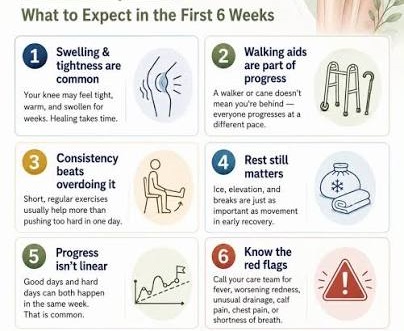
You will usually be up and walking with a walker or sticks on the same day or the day after surgery. This is deliberate: early movement reduces the risk of clots and stiffness. Expect swelling, bruising that may track down the shin, and disturbed sleep. Pain is managed with a combination of medicines rather than one strong drug.
The work of this week is bending, straightening and walking a little, often. Getting the knee fully straight matters as much as bending it — a knee that will not straighten is harder to correct later than one that is slow to bend.
Weeks two to three
Stitches or clips come out around this point. Many people feel worse in week two than week one — the initial adrenaline has gone and physiotherapy is demanding more. This is normal and not a sign something is wrong. Tiredness is common, partly from mild anaemia.
Weeks four to six
Walking distance increases and support is gradually reduced. Most people are managing stairs, and many are driving again by around six weeks — but that depends on which leg, on being off strong painkillers, and on being able to perform an emergency stop comfortably. Confirm it before you drive rather than assuming.
Swelling and warmth around the knee can persist for months. Night discomfort is common well beyond six weeks.
What is worth a phone call
Contact the clinic — do not wait for the next appointment — if you notice:
- fever, or increasing redness, warmth or discharge from the wound;
- calf pain, swelling or tenderness, especially one-sided;
- sudden breathlessness or chest pain (this needs emergency care, not a call);
- pain that is escalating rather than gradually settling;
- a knee that is getting stiffer week on week despite physiotherapy.
Surgery resurfaces the joint. It does not restore movement on its own — the physiotherapy does that, and only if it is done consistently.
The thing that most affects the outcome
It is the physiotherapy, done consistently, in the first six weeks. The range of movement established early is broadly the range you keep. Surgery resurfaces the joint; it does not restore movement on its own.
This article is general information, not medical advice. Every case differs — please discuss your own situation in consultation.