
In short
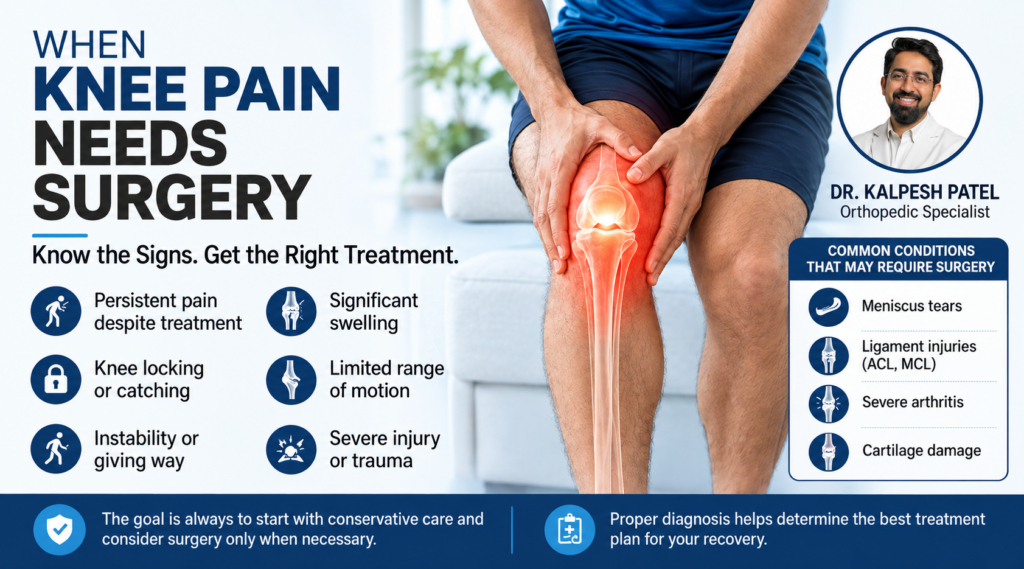
Most knee pain settles without surgery, and much of it without a specialist. What changes that: a knee that locks, gives way, swells within hours of an injury, cannot bear weight, or is hot and painful with fever.
Knee pain is common and usually self-limiting. Seeing a surgeon early does not make a knee better faster, and it is not necessary for most episodes. There are, however, patterns that should not be managed with patience and painkillers.
See someone urgently if
- the knee gave way or locked and will not fully straighten;
- it swelled rapidly — within an hour or two — after an injury;
- you cannot bear weight on it;
- it is hot, red and painful with fever, which can indicate infection;
- there was a significant injury and the knee feels unstable.
Worth an appointment, not an emergency
- Pain that has not improved after six weeks of sensible self-management.
- Pain that wakes you at night regularly.
- Swelling that keeps returning.
- Increasing difficulty with stairs, or with getting up from sitting on the floor.
- A knee that is gradually becoming bow-legged or knock-kneed.
What sensible self-management looks like
For a recent, mild strain without the warning signs above: relative rest rather than complete rest, ice for short periods in the first few days, and simple pain relief if you can take it. Keep moving within comfort. Prolonged complete rest tends to make knees stiffer and weaker, which makes the pain last longer.
Strengthening the quadriceps and hip muscles helps most non-traumatic knee pain, including early arthritis. It is unglamorous and it works, but it takes weeks, not days.
A useful consultation tells you three things: what is wrong, what your realistic options are, and what happens if you do nothing for now.
What a consultation should give you
A useful assessment tells you three things: what is actually wrong, what your realistic options are, and what happens if you do nothing for now. That last one is a legitimate option far more often than people assume — a knee with early arthritis and good movement is frequently better served by strengthening and time than by surgery.
Be wary of any recommendation for surgery made without weight-bearing X-rays and a proper examination, and of any that does not include what the non-surgical path would look like.
This article is general information, not medical advice. Every case differs — please discuss your own situation in consultation.